Category Archives: New Mexico

What a Fun Day! – August5, 2018

This area of Alaska has an average of 10 to 12 inches of rain per year and we must have experienced 6 inches since we got here.  Today’s forecast is for 1 or 2 more inches but that didn’t stop or slow down the activities for one minute.

We started by boarding the Riverboat Discovery on the Chena River with Captain Kai, who made history in 1998 by becoming the youngest woman to be certified by the Coast Guard as  a sternwheel riverboat Captain.  We’ve taken many riverboat cruises on our travels but this stood out as probably the best ever.DSCN8613  Before we started, however, we had to go to the 40 Below Room in the gift shop for a picture with our new friends and the sense of what that temperature feels like.  Needless to say, we didn’t stay in there long.20180815_190907.jpg

This particular company started over 100 years ago and remains a family owned business with sons, daughters, grandchildren and even a great-grandchild working in entry level tasks.  We started down the river seeing some beautiful homes like thisDSCN8611 that makes me think of the “dry” cabins we’ve seen elsewhere with no water, plumbing, or electricity.  Definitely a land of contrasts.  Then we watched a prearranged takeoff and landing of a seaplane right in the river near the boat.DSCN8578  We were told that 84% of the population has an airplane of some kind. We listened and watched while eating wild blueberry donut.

Then came a stop at the home and kennel of Susan Butcher, four time winner of the Iditarod and first woman ever to win it.  Susan passed away in 2006, a Cancer victim, but her husband Dave and two daughters continue the legacy.  From the ship we watched Dave take a team of dogs through their paces and watched as some puppies got their fun time training.

DSCN8592

These dogs are so strong they have to tie off the ATV until they are ready to go.  They use ATV in place of sled when no snow to keep training up during summer months


Farther down the river, they have created a replica of aa Athabascan Indian village complete with Alaskan guides.DSCN8599  Check out the picture of the two moose with locked horns. IMG_2578 They were found locked together in the ice where they died because they could not unlock themselves.

Back to port for family style lunch of stew (not sure if it was beef or reindeer or something else) veggies, salad, sourdough bread, and some kind of chocolate dessert.  Then back on the coach to head to Gold Dredge 8.

DSCN8618

This was a functioning gold dredging operation from 1928 to 1959 when the government fixed price of gold at $35 an ounce made it no longer profitable and caused the company to permanently close down.  Up until then, they had been extracting 4,000 ounces of gold every two weeks.  After seeing all that was out there, we had an opportunity to pan for gold ourselves. DSCN8622 Jim and I combined took home $22 worth of gold.  Of course, they then wanted to sell you a $50 locket to put it in.  I’ll pass.

I forgot to mention this dredge is really close to the pipeline so Jim finally got a picture in the blog.DSCN8626


Suspending the Trip – December 4, 2012

We spent yesterday exploring pistachio groves (one of the largest in the country) and Lincoln (the badlands where Billy the Kid was arrested).  It was lots of fun, but we got some news this morning that changes things and we are suspending our trip.

Our brother-in-law, Bruce Horrocks, lost his battle with cancer this morning and kept his reservation with heaven.  We will be travelling over 2,000 miles in the next three days to get back to Pennsylvania for his service on Saturday and to be with Carol, Jim’s sister.

White Sands at Alomogordo, New Mexico – November 30 and December 1, 2012

When we left Fredericksburg, we had a one night stay at Van Horn, Texas to get us closer to our real destination of Alamogordo, New Mexico.  Back in 2006 when I retired from the Bank, we took a month-long trip through Houston to San Antonio to New Mexico, Colorado, North Dakota, Pennsylvania and back to Florida.  While driving in New Mexico we notice this White Sands National Monument on the map and decided to stop.  We could only spend a few hours because we had a reservation down the road we needed to get to, but we felt like we had discovered a treasure and always wanted to return and spend more time.

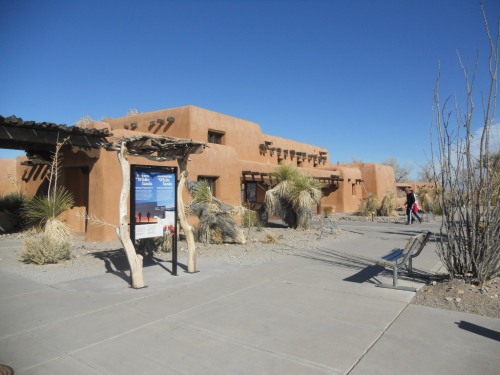
Entrance to White Sands Monument

Entrance to White Sands Monument

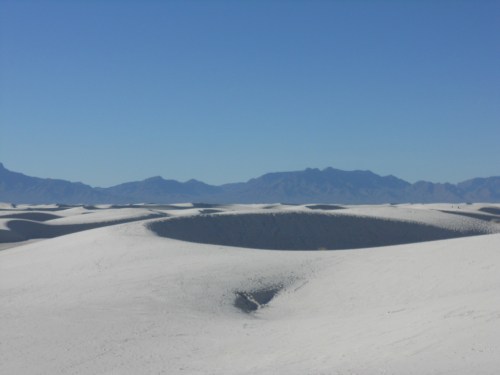
Dunes in White Sands

Dunes in White Sands

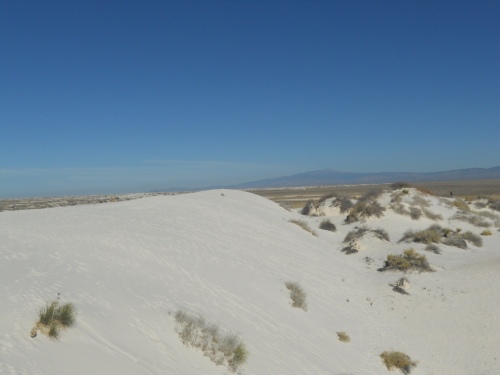
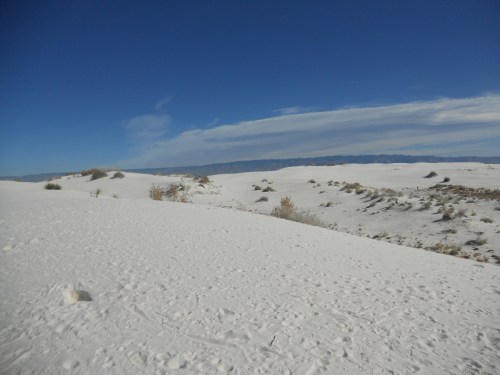
Dunes go on for miles

Dunes go on for miles

DSCN4165Geologically, White Sands desert is relatively new.  It’s only about 4,000 years old but a very interesting story.  The gypsum (hydrous calcium sulfate) comes from the San Andres Mountains to the west of the basin.  When it rains the gypsum-bearing marine deposits are trapped in the basin and dry into selenite crystals that look like chucks of root beer colored tubes, some three feet long.  The wind, freezing and thawing process, and wetting and drying process breaks down the selenite into smaller sized pieces and eventually into white gypsum sand.  We have been told that in the Spring, the winds can be 70 miles per hour.  This wind not only contributes to the breaking down process, but creates these huge dunes and forms fascinating habitats for animals and vegetation.

Unique to this deposit is its size.  It is currently 275 square miles.  There are two other areas in Mexico with gypsum deposits; one is 2 square miles and the other 8 square miles.  So you see, this desert is a national treasure.  Fortunately, it was recognized as such in 1933 and it was declared a National Monument by President Hoover.  Over the 4,000 years of its existence, the typical desert animals, (kit foxes, pocket mice, lizards, insects and snakes) have all evolved into lighter colored variations so they are not readily seen in the white sands.  You can imagine how quickly a dark brown little mouse would be seen by any predator contrasted against the pure white shiny sand.

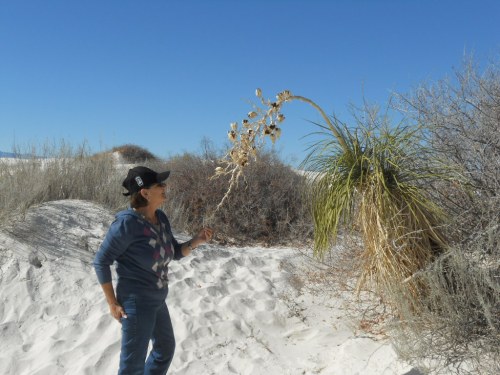
Even the plants have compensated.  The  yucca,

MG studying the Yucca Tree

MG studying the Yucca Tree

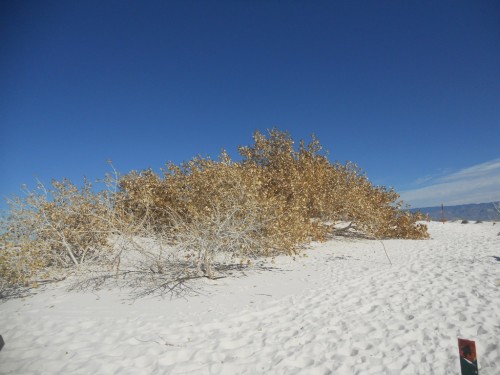
normally seen in the desert, grow quickly to make sure they stay above the rapidly moving white sands and continue the photosynthesis process needed for life.  There are 40 foot tall Cottonwood trees covered with only 10 feet still exposed yet living successfully in the dunes.  It’s amazing to see.

Cottonwood tree probably 30-40 feet tall burried by white sand

Cottonwood tree probably 30-40 feet tall burried by white sand

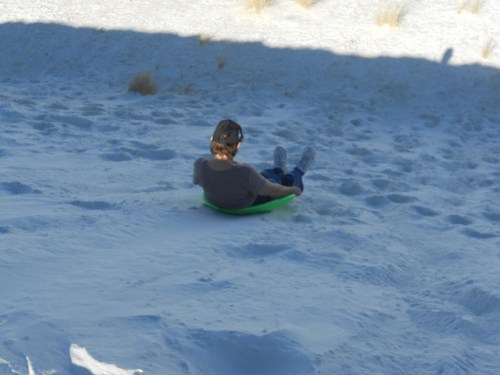
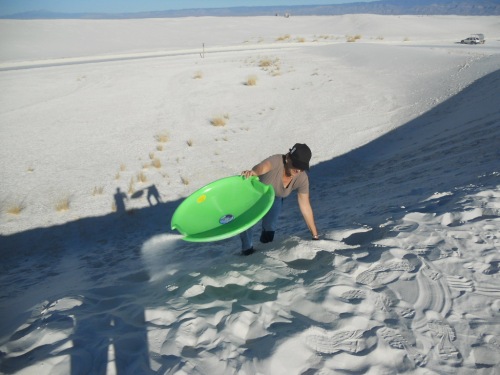
The most amazing thing about this place is there are almost no rules.  Every State and National Park we have gone to had big signs everywhere telling the visitors where they could not go and not touch.  Here at White Sands, there are no rules.  It’s not only that you can walk anywhere in the sand or touch the plants, they actually encourage it.  They have marked trails of varying difficulty taking you into the white sand and past all the habitats.  In the summer, they have ranger guided walking tours and special events of all kinds.  The best part is the dunes create the best hills for sledding.  The gift shop sells sno-saucers and wax to use to slide down the dunes and every kid and kid-at-heart try it.  We were no exception.  Unlike skiing with the tow-ropes or comfortable lifts, you have to walk back up the hill for a second or third run.  This is where the kids and the kids-at-heart get separated.  Three or four of those hikes back up the slopes and we were done.

MG sledding down one of the dunes

MG sledding down one of the dunes

The climb back up the dune was the tough part

The climb back up the dune was the tough part

It immediately reminded me of visiting our daughter and her family in Chicago in the Winter.  They had a berm at the back of their home that was a perfect sled ramp when it snowed.  The big difference here was it was not cold!  The white sand is so soft and cool but does not stick to you like beach sand.

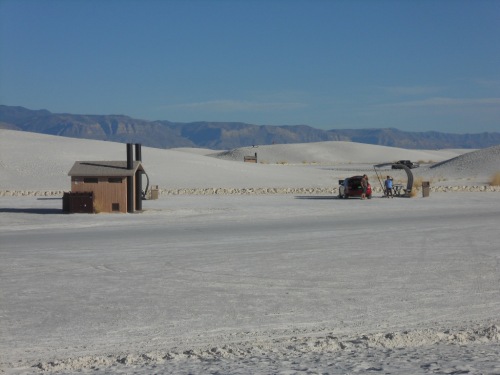
Picnic area in the park right by the dunes

Picnic area in the park right by the dunes the little house with two pipe is the rest room you can see dunes in the background that people were sledding on.

There is a picnic area perfect for families who want to spend a day outdoors for little cost and wear the kids out.  With so few restrictions, parents don’t have to worry if their children are getting into something they can harm.  The children are safe as well because all of the animals are nocturnal and stay far away from the people during the day.  We were told the thing people like to do the most in the sand is run barefoot.  Of course, that was our signal to try it, although we did not run but walked.

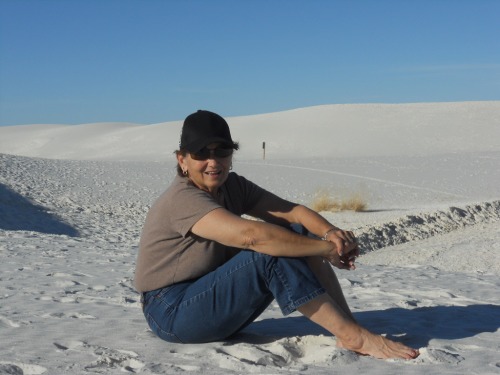
Resting on the dune notice the bare feet.

Resting on the dune notice the bare feet.

It was a very pleasant feeling and we found ourselves just sitting on the sand like we were at the beach watching the kids playing and the scenery.

Every few weeks there is a strong wind that passes through clearing away footprints, creating more sand and shifting the existing sand further east until it blows away as powder.  How perfect is God’s creation.

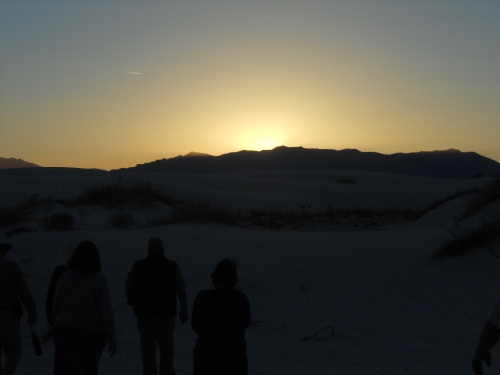
Sunset at White Sands -  sun going down over the San Andres mountains

Sunset at White Sands – sun going down over the San Andres mountains

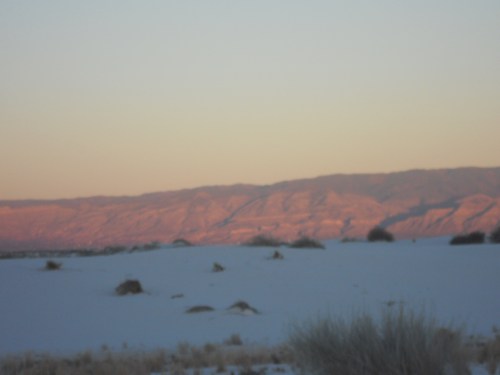
Opposite direction- sun was shinning on Sacramento Mountains

Opposite direction- sun was shinning on Sacramento Mountains

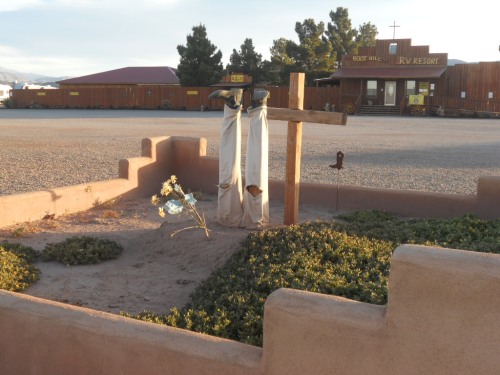
I had to add this picture of the front of the campground, our campground was named Boot Hill RV Park. Not sure who the guy is that is buried here.

Front of Campground where we stayed in Alamogorda, NM

Front of Campground where we stayed in Alamogorda, NM